Showing posts with label nonprofit. Show all posts

10/09/2015

Muddying the Waters: North Korea’s Deceptive Media Offensive


By Greg Scarlatoiu

Greg Scarlatoiu is executive director of the Committee for Human Rights in North Korea (HRNK) in Washington, D.C. At HRNK, he supervises, manages, and coordinates the drafting, publication, and dissemination of reports investigating the North Korean human rights situation. In close coordination with HRNK’s board of directors, Scarlatoiu shares HRNK’s findings and recommendations with UN agencies and international NGO networks. A seasoned lecturer on North Korean human rights, political security, and economic issues on the Korean peninsula, he has appeared as an expert witness at several Congressional hearings on North Korean human rights. An experienced social audit consultant, he is currently finalizing a report on North Korean workers officially dispatched overseas. For twelve years, Scarlatoiu has been authoring and broadcasting the weekly Scarlatoiu Column to North Korea for Radio Free Asia (RFA). A visiting professor at Hankuk University of Foreign Studies (HUFS) in Seoul, he holds a Master of Arts in Law and Diplomacy (MALD) from the Fletcher School at Tufts University, and an MA and BA from Seoul National University, Department of International Relations. Scarlatoiu was awarded the title of Citizen of Honor, City of Seoul, in January 1999. He is fluent in Korean, French, and Romanian.


On Monday, September 21, 2015, the 30th session of the Human Rights Council in Geneva featured a panel discussion on the situation of human rights in the Democratic People's Republic of Korea (DPRK), including the issue of international abductions, enforced disappearances, and related matters, moderated by Michael Kirby, former chair of the Commission of Inquiry on human rights in the DPRK (UN COI). The panelists included Mr. Koichiro Iizuka, vice secretary-general of the Association of Victims Kidnapped by North Korea.

The main panel was followed by a side event featuring the tragic accounts of South Korean, Japanese, Romanian, Thai, and other nationals abducted by North Korea. The panelists included Mr. Hwang In-chul, whose father was a passenger on Korean Air Lines YS-11, hijacked by North Korean agents on December 11, 1969. Mr. Hwang's father was one of 11 passengers and crew members who were never returned to South Korea.

On the same day, CNN’s Will Ripley and Tim Schwarz published a story based on sources inside North Korea, claiming that Ms. Mun Su Gyong, a North Korean national, was allegedly abducted by South Korean agents while working as a waitress at a North Korean state-owned restaurant in Phnom Penh, Cambodia. One of the sources quoted is the former manager of the respective restaurant, who reportedly believes that South Korean spies posing as North Korean businessmen “frequented the restaurant for two years,” befriended Ms. Mun, and then abducted her, forcing her into a car and driving away. At the time of the alleged “abduction” four years ago, Ms. Mun was twenty years old. The report included an interview with Ms. Mun’s parents.

Source: CNN

By offering this story to a prominent U.S. media organization, the North Korean authorities likely attempted to counter efforts by the UN and the international community to focus attention on South Korean nationals and citizens of other countries abducted by North Korea. As we learned from an excellent David Hawk piece published by US-Korea Institute’s 38 North about a year ago, the North Korean government reacted to the highly critical report of the UN COI through: a “counter-report” by the North Korean Association of Human Rights Studies; a significantly revised approach to the Universal Periodic Review (UPR) mechanism; and a diplomatic “counter-offensive,” which involved the North Korean foreign minister appearing before the UN General Assembly for the first time in 15 years, and so-called “press briefings” focused on denial of the appalling North Korean human rights record.

By offering this story to a prominent U.S. media organization, the North Korean authorities likely attempted to counter efforts by the UN and the international community to focus attention on South Korean nationals and citizens of other countries abducted by North Korea. 


As part of the same strategy, the North Korean regime’s propaganda website, Uriminzokkiri, launched ferocious attacks against UN COI witnesses, including former political prisoners Jung Gwang-il and Shin Dong-hyuk, and also North Korean defector and scholar Cho Myung-chul, the first North Korean escapee to become a South Korean National Assembly member.

On the upside, the North Korean regime’s approach to human rights has surely changed post-UN COI. Its fundamental strategic stance on human rights used to be utter neglect. Always overshadowed by nukes and missiles, human rights would easily disappear off the radar screen of the international community, so the Kim regime knew there wasn’t much to worry about. Post-UN COI, even the North Korean regime has come to the realization that human rights is here to stay, and it can no longer just ignore attempts by UN agencies, foreign government agencies, and international NGOs to shed light on its abysmal human rights situation. Pursuant to the findings of the UN COI, North Korea is no longer seen as a bizarre relic of the Cold War, but as a post-communist, post-industrial, dynastic kleptocracy that is subjecting its own people to crimes against humanity in order to maintain its grip on power.

Post-UN COI, even the North Korean regime has come to the realization that human rights is here to stay, and it can no longer just ignore attempts by UN agencies, foreign government agencies, and international NGOs to shed light on its abysmal human rights situation.


On the downside, North Korean attempts to compromise witnesses and muddy the waters by misleading foreign media organizations will continue. Since the release of the UN COI report in February 2014, CNN has done excellent reporting on the North Korean human rights situation, and perhaps that is why it was the media organization targeted by North Korea’s deception in this case. 

In the particular case of the young North Korean woman allegedly “abducted” by South Korean agents, the story, published undoubtedly with the approval of the North Korean authorities, presents the following problems:


  • The former manager of the respective restaurant claims that Mun Su Gyong had been befriended by "South Korean spies" posing as North Korean businessmen. I have interviewed former restaurant workers who escaped and found their way to South Korea. The waitresses' "befriending" customers is reportedly a big red flag for the managers running these restaurants. The girls who get too close to customers are quickly disciplined, and in extreme cases sent back to North Korea. Sustaining such "friendship" with customers, well known to other waitresses and the manager, would be impossible. One has to remember this is a tightly confined space. The waitresses work and live together under strict surveillance. They are only seldom allowed to go shopping or sightseeing, and even then only in groups, never alone. 
  • With 28,000 former North Koreans already living in South Korea, including some former senior officials, there is absolutely no conceivable need for South Korean intelligence agents to kidnap North Koreans. 
  • There are former restaurant workers already living in South Korea. There would be no practical need for South Korean intelligence agents to kidnap additional restaurant workers. 
  • South Korea is a liberal democracy that has discarded the dark legacy of its authoritarian past. The UN Secretary-General is a South Korean national, the president of the World Bank is a Korean American born in South Korea, and South Korea contributes in many meaningful ways to international humanitarian and development assistance as well as peacekeeping operations. South Korea is not a rogue state conducting abductions of its own nationals or other countries' nationals overseas. It is North Korea that has kidnapped nationals of South Korea, Japan, China, France, Guinea, Italy, Jordan, Lebanon, Macau, Netherlands, Romania, Malaysia, and Singapore.

It is North Korea that has kidnapped nationals of South Korea, Japan, China, France, Guinea, Italy, Jordan, Lebanon, Macau, Netherlands, Romania, Malaysia, and Singapore.

To the reader interested in learning more about North Korea’s abduction of citizens of South Korea and other countries, I highly recommend HRNK’s report “Taken,” by Yoshi Yamamoto, published in the spring of 2011. While I do hope that, if she is indeed alive and separated from her family, Mun Su Gyong will be reunited with her loved ones, one has to remember: 82,959 South Koreans were abducted by North Korea during the Korean War; 3,824 South Koreans, most of them fishermen, have been abducted since the July 27, 1953 Korean War Armistice; 93,000 ethnic Koreans residing in Japan were lured back to North Korea and never allowed to leave, many of them trapped together with Japanese spouses; hundreds of Japanese and Chinese nationals have been abducted to North Korea; and at least 25 nationals of countries other than South Korea, Japan, and China have been reportedly taken against their will. With 180,108 nationals of South Korea and other countries taken by North Korea, that regime must provide a full accounting of those abducted and detained, facilitate the reunification of abductees’ families, return the remains of deceased abductees, and observe the right of freedom of movement by allowing the surviving abductees to return to their families. With abductions by North Korea featured prominently in UN Special Rapporteur on the situation of human rights in the DPRK Marzuki Darusman’s most recent September 8, 2015 report to the General Assembly, this issue is here to stay. The North Korean regime should rest assured that its attempts to muddy the waters and run anti-human rights media campaigns will, once again, be doomed to failure.

With 180,108 nationals of South Korea and other countries taken by North Korea, that regime must provide a full accounting of those abducted and detained, facilitate the reunification of abductees’ families, return the remains of deceased abductees, and observe the right of freedom of movement by allowing the surviving abductees to return to their families. 

To download a free PDF copy of “Taken,” go to: http://hrnk.org/uploads/pdfs/Taken_LQ.pdf.

9/28/2015

An Interview with HRNK Report Author David Hawk

HRNK Hidden Gulag series report author David Hawk discussing North Korea’s prison camps with HRNK.
© 2015 Committee for Human Rights in North Korea


On August 24, 2015, HRNK Director of Programs Rosa Park and Outreach Coordinator Raymond Ha traveled to David Hawk’s home in New Jersey to interview the author on his upcoming report for HRNK, The Hidden Gulag IV: Gender Repression and Prisoner Disappearances. This report, along with North Korea: Imagery Analysis of Camp 15 “YodĹŹk” –Closure of the “Revolutionizing Zone”by AllSource Analysis and HRNK, was launched on September 18, 2015 at the Newseum in Washington, D.C.

Interviewer: How did the first Hidden Gulag come about?

David Hawk: Well, when the Committee for Human Rights in North Korea was first formed, it was known generally but vaguely that there were prison camps of some sort or another in North Korea, and they hired me to go to South Korea at a time when there were 3,000 refugees or defectors from North Korea who had gone to China and come around to South Korea via Mongolia or via Southeast Asia. Among the 3,000 refugees or defectors, there were several score who had been imprisoned while they were still in North Korea. So, I was hired to go to Seoul and interview them and prepare a report on political prison camps in North Korea.

The Committee [for Human Rights in North Korea] had decided that rather than hire a Korea specialist or a Korean speaking scholar, they wanted someone with a broad background in human rights and a broader background in phenomena of repression in a variety of countries and political situations. Since I had previously worked on documenting the Khmer Rouge genocide in Cambodia and the massacres in Rwanda, I had experience with documenting worst case violations. So, they asked me if I would be interested in undertaking a study, and I was very much interested because when I was Executive Director and then on the board of Amnesty [International] and on the board of directors of Human Rights Watch Asia in the 70s and 80s, we both at Amnesty and Human Rights Watch did a lot of work on South Korea at a time when South Korean students and workers and pastors and journalists were very actively engaged in protesting the military dictatorship. While we were doing that work in the late 70s and 1980s, we were aware that it was probably much worse in North Korea than it was in South Korea in terms of human rights violations, but there was no information or the possibility to get information on North Korea in those decades.

So, when they told me that there were several dozen former North Koreans who had been in various prison situations in North Korea, I thought this would be a very interesting challenge and opportunity to fill in that gap in our knowledge of repression around the world. That is, if you go back and look at the annual reports of Amnesty International or the annual reports of Human Rights Watch when that NGO was started, and you look in the annual reports for the entries on North Korea, mostly what you see is a paragraph saying, “We don’t have any information.” Yet, you’d have pages and pages on human rights violations in South Korea because we were able to get the name, information, and circumstances of pretty nearly every student, pastor, or worker who was arrested protesting the military dictatorship. So I thought this would be a unique challenge and an opportunity to fill in that gap in our knowledge of repression around the world.

Interviewer: You are now on the fourth edition of The Hidden Gulag. What got you interested in the topic of North Korean political prison camps?

Hawk: Well, it was known, vaguely, generally, that there were prison camps of one sort or another in North Korea. This was known primarily by the Korea scholars who had looked at the purges of the Workers’ Party, the army, and the general populace in the late 1960s and 70s. But it was a consensus, a global consensus, that these sorts of concentration camps, labor camps, political prison camps, were a phenomena associated with the totalitarian regimes of fascism and communism that were supposed to have gone from the scene at the end of WWII or following the death of Stalin. So, the idea that there were ongoing political prison camps or concentration camps or forced labor camps, as they are variously called, was something that struck the members of the committee as something that should not be existing in the 21st century, as this was part of the awful residue of the 20th century.
Well, it was initially the members of the Board of the Committee for Human Rights in North Korea that selected the topic, and the reason they were interested was that it was widely thought that concentration camps, forced labor camps, and political prison camps were a phenomena that were associated with the terrible human destructions in the 20th century with European fascism or Soviet communism. It was known vaguely and generally that there were prison camps of some sort in North Korea because the Korea scholars had tried to document Kim Il-sung’s purge of the party, the army, the government, and the general populace of Korea. There was a consensus certainly in human rights and much broader circles that these kind of gross human rights violations are something that should have passed from the scene at the end of WWII, certainly by the end of the 20th century.

Interviewer: How has The Hidden Gulag research methodology changed over the years?

Hawk: The biggest change in research methodology was the availability of Google Earth. For the first edition of The Hidden Gulag, what we did was obtain very detailed maps of North Korea basically dating to the 1950s. These were maps of North Korea by the U.S. Army that were by this point unclassified; they were very detailed and had degrees of latitude and longitude. These were very large maps; we’d roll them up and send them in mailers to our colleagues in Seoul, who would bring the former North Korean prisoners to their offices, and they’d look at the map, try to find the prison camp on the map, plot the coordinates, and we then would call up one of two commercial satellite photograph companies and see if they had any footage available for those coordinates. We’d then print out the footage—these were about 2 feet wide and 12 feet long— and we’d roll up those, send them to our colleagues in Seoul, who would again call the former political prisoners to their offices, and they’d then pore over for hours the satellite images of the camps. They were quite surprised because they could find their houses and their work units and other landmarks in the prison camps and identify them. 

We then used computers to input their identification onto the satellite photographs. It was a bit of a hit or miss process in that sometimes they picked the coordinates of the nearest town and they could recognize the road, but the prison camp itself was a little further away. So we’d get another set of coordinates and call back the satellite companies to see if they had in their storage discs any satellite imagery for the new coordinates, send the new coordinates, and mail them back over to Seoul. This was a very arduous process. It took an extra six months to do this process of getting the satellite imagery.

The author at home in New Jersey looking at satellite imagery provided by AllSource Analysis.
© 2015 Committee for Human Rights in North Korea


The satellite imagery was enormously important because it backed up the prisoners’ testimony about places that the regime denies exists. Of course, the regime won’t allow the ICRC [International Committee of the Red Cross] to have access to any of these facilities; nobody gets to see these places. It was very important to have the satellite images. After Google Earth came online, it became very, very easy. In fact, the Korean language version of Google Earth is very good and very precise. If you take the English language version and type in a romanized Korean name, you don’t get very much. But if you’re working off the Korean language Hangul script in Google Earth, and you type that in, it just zooms right to it. It’s now very, very easy for North Koreans to go online and look at their hometowns and places they visited, and, in this case, the prison camps where they were detained and subjected to forced labor.
The reason that it is important to do periodic updates is because we’re in the odd situation of only being able to find out about human rights violations in North Korea between two and five years after the violations occur. So we’re constantly playing catch up, as it were. What has to happen in terms of arbitrary detention, political imprisonment, and forced labor is that you have to wait until after the prisoner is released or, in a couple of cases, escapes, and then spends several months or even several years inside North Korea plotting the escape to China. The refugees in China spend months or several years getting enough money, making enough connections for the journey from Northeast China through Mongolia, or down through south China and Southeast Asia to get to Seoul. It’s not until the former prisoners get to Seoul that they’re really accessible to foreign journalists, or particularly Western journalists, scholars, or human rights investigators.
Because North Korea doesn’t allow North Korean citizens to make international phone calls or to have access to the Internet, there is a two to five year time lag between the time when violations occur in North Korea and when the outside world can find out about it. The prisoners have to be released, and they spend several months, possibly several years, in North Korea organizing their defection, their escape to China. Most of the North Korean refugees in China need to spend months, or even several years in China obtaining the funds and making the connections necessary for the onward journey from Northeast Asia down to south China and then through Southeast Asia or sometimes through Beijing and then Mongolia. It is not until these former victims of human rights violations reach South Korea that they’re available to Western journalists or scholars or human rights investigators. This process can take two to five years, so we’re in a constant catch-up game trying to find out recent developments. Recent developments aren’t like in the rest of the world where recent developments are something that happened yesterday or ten minutes ago that just was put on YouTube or over the Internet. There is this long delay, and up to now, there was no way around that, really.

Interviewer: What is the most interesting thing you found while interviewing these three women?

Hawk: Actually, I interviewed seven or eight women, but three from this particular kyo-hwa-so prison where they just built a new wing of the prison to accommodate the increasing number of women prisoners. Jongo-ri Kyo-hwa-so is written up in the first and second editions of The Hidden Gulag when it was a men’s prison. But we learned that, six years ago or so, the authorities constructed a new area of the prison to accommodate around 1,000 women prisoners. I interviewed three women prisoners from the Kyo-hwa-so Number 12. 


Google Earth and © 2015 DigitalGlobe image of Kyo-hwa-so No. 12 Jongo-ri, 6/29/2015
© 2015 Committee for Human Rights in North Korea

What was most interesting was the senselessness and the perniciousness of punishing these women for having gone to China in search of food because of the chronic food shortage, particularly in the northeast provinces of North Korea, or for employment so they can get the money so that their families back in North Korea can buy food in the markets. It’s actually one of the articles of the Universal Declaration of Human Rights that people have the right to leave and return to their country of origin. This right is also included in the international law forum–the International Covenant on Civil and Political Rights extends the right to leave and return to one’s country of origin. But North Korea makes that a crime. Previously, tens of thousands fled at the height of the famine in North Korea. 
Currently, large numbers of North Korean women who, because of the food shortage and because there is no work in North Korea, go to China and work in service industries of various kinds. They are treated as illegal immigrants once in China. The Chinese police catch them and repatriate them to North Korea where they are punished, severely in many cases, for having left their country of origin in search of food or money to buy food. Those North Koreans who are repatriated and investigated by the North Korean police after they are repatriated, if the North Korean authorities believe there was the intent to defect to South Korea, then those forcibly repatriated North Koreans are sent to the kwan-li-so political prison camps. There are tens of thousands of North Korean women who were in China not with the intent to flee to South Korea but to get food or to find a job. Because of the harshness of the punishment, it sets up a terrible situation for these North Korean women in China. There is a separate report on this: Lives for Sale by the Committee [for Human Rights in North Korea] which came out several years ago. 

This process is also detailed in the 2nd edition of The Hidden Gulag that discusses where the North Korean refugees in China are repatriated from and the different kinds of punishments that are meted out to them. But the fact that the punishment is so severe sets up a terrible situation where North Korean women in China are subjected to trafficking and a lot of other violations and very difficult situations. This happens because of the senseless punishment of the North Korean women who have gone to China in search of food or employment. So, the most interesting thing about the three women from Jongo-ri Kyo-hwa-so was the senselessness of their imprisonment and their severe punishment under very brutal conditions and the perniciousness of the risks that this exposes North Korean women to in China. It’s senseless and it is pernicious. 

They were using prison labor to make wigs and eyelashes that were probably being sold in China or shipped somewhere else. 

The other interesting thing about the women’s section at Jongo-ri Prison was that in addition to the normal forced labor, which is mostly agricultural production or mining or timber cutting, at Jongo-ri there was a work unit to make wigs and one to make eyelashes. The prison was getting boxes of hair that were sent from Pyongyang, but the prisoners believe that the hair was being collected in China, and the women prisoners would sort the hair into color and length, thread the hair into needles, sew the hairs into the fabric that was going to go next to the head, and then the wigs would be returned and sent somewhere else for finishing. They were using prison labor to make wigs and eyelashes that were probably being sold in China or shipped somewhere else. I hadn’t encountered that kind of forced labor for those purposes. There was another women’s prison in Kaechon where there were textile units that made clothing for sale abroad, but I hadn’t encountered the forced labor for wig making or eyelash production previously. I found the women’s testimony about the production techniques for making wigs in a terrible North Korean prison interesting to hear about.

Interviewer: Why should we, as the American public, care about these political prison camps halfway around the world? Why should we keep track of ongoing changes?

These are not your run-of-the-mill prisons. 
People are being persecuted and subjected to forced labor under extremely brutal conditions for having exercised their rights. 
They are being detained arbitrarily, and their detention constitutes crimes against humanity. 

Hawk: The severe violations that are the phenomena of repression associated with these prisons, prison camps, forced labor in North Korea are gross violations of internationally recognized human rights, and they are what are considered to be worst-case violations, which are really atrocities and are recognized in international law as atrocities, as crimes against humanity. These are not your run-of-the-mill prisons. People are being persecuted and subjected to forced labor under extremely brutal conditions for having exercised their rights. They are being detained arbitrarily, and their detention constitutes crimes against humanity. The same reason that international public opinion as a whole should care about the crimes against humanity in North Korea is for the same reason that people care about genocides in Cambodia or Rwanda, or the anarchy, the dreadful situation in eastern Congo. These are worst-case violations, they shouldn’t be occurring in the 21st century. The only recourse available is to try to mobilize international public opinion and the governments of other nation-states around the world to try to put pressure or try to persuade the North Korean authorities that it has to improve the human rights situation in North Korea.

Interviewer: On that note, why should the international community be concerned about the North Korean political prison camps and the ongoing changes?

Hawk: As I mentioned before, there is a two to five year delay from the time violations are committed until the outside world can find out about it. We know that there are enormous changes going on in North Korea from the bottom up, primarily with the creation of markets, which the regime in the 1990s and first decade of the 20th century tried very hard to suppress but did not succeed in suppressing. Now, the real life situation of most North Koreans is very different from what it was a decade ago because they now get their food and their clothing not through the Public Distribution System or from factories or mines that aren’t working but from markets. We know that there are changes. We also know that information from the outside world is increasingly seeping into North Korea in the form of video, radio broadcasts, and on DVDs and thumb drives, so we want to try, even though there is a time delay between when the violations are committed and we find out about it, we still want to see what these developments are, and particularly, hopefully, if there are some improvements. 

I have, it’s only a general sense, but I believe there are less public executions going on in North Korea than was the case in the 1990s and the early part of the 21st century. I believe that the number of public executions has gone down. It is my sense also that there are fewer North Koreans who are being imprisoned for the political offenses of their parents or their grandparents. It is a very unusual phenomena of oppression that was unique to North Korea, although it was practiced during the Chosun dynasty in the 18th and 19th centuries. We hear fewer reports of people being imprisoned and subjected to forced labor for the political offenses, real or imagined, of their grandparents. Since the North Korean authorities won’t allow human rights investigators or the Red Cross or NGOs like Amnesty or Human Rights Watch to go in and make on-site confirmations of either the claims of the government or the testimony of the refugees, we need to as best we can keep track of the most recent developments, even if the most recent developments are two to five years previous.

Interviewer: You include a list of 121 missing people in your report. How do you recommend that we find these missing people?

Hawk: Well, let me first explain what the missing people are and how we come by their names. The report that the Committee [for Human Rights in North Korea] put out a year and a half ago talked about the dismantlement of Camp 18 and the closure of Camp 22. When Camp 22 closed, the prisoners at night were trucked to a train station in Hoeryong, North Hamgyong Province. The trains departed going south. We don’t know what happened to those people. There are sketchy reports that they were transferred to Camp 16 or Camp 14 when they closed Camp 22, but the satellite imagery of Camp 14 or 16 doesn’t show the expansion of those camps sufficient to accommodate the former prisoners of Camp 22. But in the case of Camp 22, we don’t have the names of individual prisoners. Our information about Camp 22 came from former guards who defected to South Korea, who told us, “We have no names of the prisoners who were in the past imprisoned in Camp 22.” 

Another one of the kwan-li-so prison camps is called Camp 15, or it’s called Yodok Camp, after the name of a local town. Camp 15 was unique in that it had portions of the prison camp that they called “total control zones,” where the prisoners were held for life. They were brought in as children or grandchildren of political offenders, or as the presumed or real political offenders themselves, and would spend the rest of their lives, as short or long as they were, in forced labor. But in addition to these total control zones, there were what the North Koreans called “revolutionizing zones,” where people who were not deemed implacable “counter-revolutionaries” were sent for a period of three to ten years of forced labor, after which they were potentially eligible for release back into North Korean society. These revolutionizing zones are sometimes called “re-education camps.” I don’t like that terminology because they’re essentially not receiving education. It’s forced labor; they are being brutally punished. Even in the re-revolutionizing zones, many prisoners die from malnutrition. There are executions. There is torture. There is nothing going on in these revolutionizing areas of Camp 15 that merit the term “educational.”


The North Korean technical term is “revolutionizing zone,” and what’s unique about this particular revolutionizing zone called Sorimchon is that one of the prisoners who was released after three years had a photographic memory. When he was first imprisoned for being forcibly repatriated from China, he was assigned to an agricultural production unit. But then he was reassigned to assist in the administration and record keeping of the Sorimchon revolutionizing section of Camp 15. As part of his work in the record keeping section, he got to see the records of prisoners, and he got to meet a lot of them in discussing their individual work assignments with them and their production experiences. This particular prisoner had a photographic memory, so when he was released and later escaped to South Korea, he, with South Korean activists, sat down and made a list of 181 former prisoners. Of those 181, some were released, a number were executed, and quite a number died of starvation and malnutrition while in the labor camp. 

Of the 181, there are 121 whose whereabouts are unknown. We know that they were imprisoned, and it is really unusual to have the names and biographical information, the prior occupation, the age, of these prisoners. Of the 181, the status of 121 are unknown. Some of them could have been released, some of them could have died in detention, some of them could been moved to the lifetime imprisonment total control zones within Camp 15. We don’t know the fate or the whereabouts of the 121 former North Korean prisoners. That is highly unusual that we have the names of any of them at all. 

In a sense, these North Korean political prisoners have doubly disappeared. They were sent to Camp 15 without any trial or judicial process or sentencing or charges. They were not imprisoned according to the DPRK Criminal Code and criminal procedure provisions. They were just abducted by the political state security police and deported to the camps. They are held in incommunicado detention. Their families or their friends or former work colleagues are provided no information about what happened to these people after they were deported to Camp 15. The technical human rights term is “enforced disappearances.” These people were grabbed by police operating on the authority of the state and simply deported or deposited in the camps, and their fates and whereabouts are unknown. That was their first forcible disappearance. Then [based on] what we saw in recent satellite imagery about actually a year ago on Google Earth, it became apparent that the prisoner residence units in the Sorimchon section of Camp 15 and the animal, it was agricultural production and animal husbandry, but the pens for the animals, the warehouses for agricultural implements, and machinery were destroyed and demolished, as were all of the prisoner housing units. The Sorimchon section of Camp 15 does not exist anymore, and so we don’t know what happened to the former prisoners from the Sorimchon section of Camp 15. But in this case we have their names and some of the personal identification about these 181, including these 121 doubly disappeared North Korean prisoners.

Interviewer: How can we hold the North Korean regime responsible for the 121 missing people included in the report?

Hawk: We actually want to hold them responsible and accountable for a lot more than the 121; it’s just that in this case, we have their names. It is a well established principle of contemporary international law that those who commit atrocities should be held accountable and should be asked to account for the violations of human rights that are so severe that they are considered to be atrocity crimes. That has do be done primarily through the efforts of other UN Member States. It’s at this point only other governments that can demand from North Korea that North Korea hold accountable those who are responsible. There are institutions and mechanisms for doing this that, as of December of last year, are employed. An overwhelming majority of Member States in the [UN] General Assembly passed a resolution requesting the UN Security Council to refer the North Korean human rights situation to the International Criminal Court for its investigation and its prosecution of those who are responsible. It’s the Member States of the UN that have to continue to pressure North Korea to improve its human rights situation and to cease these criminal violations and to bring those who are accountable to justice. We are a long way from that happening, but it’s only since the international community took these measures in 2014 to raise the issue of accountability and obtain an account of these dreadful ongoing violations that the North Korean regime has responded at all to the concerns of the international community. 

Prior to this, there had been a decade of resolutions at the UN Human Rights Council. There had been a decade of reports by the Special Rapporteur. There had been a decade of resolutions at the General Assembly, and North Korea ignored all of that, all of those resolutions, all of those reports. It’s only when the international community raised the issue of accountability that the North Koreans responded. They responded in a variety of ways, none of which are the responses that are desired, such as allowing the ICRC to conduct on-site investigations, or for the regime to admit that these violations are taking place, that these prison camps exist. It’s only when the international community, other governments raised the issue of accountability that North Korea responded at all, which is why it’s important to continue to update the situation and continue to request that other governments continue to persuade the North Korean government to change its policies.
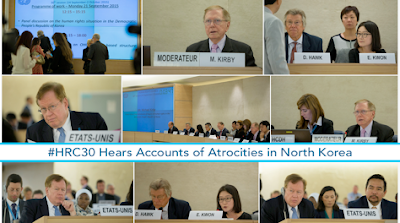

David Hawk representing HRNK at the UN Human Rights Council’s 30th Session on Sept. 21, 2015 in Geneva, Switzerland. © 2015 U.S. Mission Geneva

8/26/2015

Training North Korea’s Supreme Leader

By Robert Collins 


How does one train a “supreme leader”—especially a young and inexperienced one—on how to handle crisis when any mention of his mistakes may lead to the notorious termination of the trainer by anti-aircraft gun? Difficult question, to be sure, but an even more difficult process. After all, North Korea had never gone to any external crisis of this depth under the short reign of Kim Jong-un, the North’s hereditary First Secretary of the Korean Workers’ Party, Chairman of the National Defense Commission, and Supreme Commander of the Korean People’s Army. Now it has.

During the past two weeks, the two Koreas have once again put on shows of military force in responses and counter-responses to the North’s planting of landmines in the Demilitarized Zone that maimed two young South Korean soldiers. The South’s response was to resume loudspeaker broadcasts across the DMZ, designed to attack and undermine the legitimacy of the regime. Essentially, these types of South Korean propaganda targeting the North’s leadership drive that same leadership up the proverbial wall. A series of kinetic responses and counter-responses elevated a provocation into a crisis requiring raises in military alerts, shows of great force on both sides and, finally, face-to-face negotiations at Panmunjom in the DMZ.

So how much “training the trainer” went into planning for these actions? Driven by fear for their lives, North Korea’s generals and admirals must couch their recommendations on courses of action within the cocoon of absolute and bellicose loyalty to the supreme leader. Most likely, they must parse their requests and answers in strategy deliberations in such a manner that makes any suggestion by Kim Jong-un appear to be sheer tactical brilliance reminiscent of Sun Tzu, Napoleon, or, even better for North Koreans, of the much celebrated greatness of the supreme leader’s grandfather, Kim Il-sung.

This loyalty demanded by the North’s incessantly inculcated ideology has definitively negative by-products that have the world’s attention—impetuous purges and executions of senior leaders, human rights denial, political prison camps; imprisoning up to 120,000 inmates; and resource de-prioritization for any individual North Korean perceived by the regime as not faithfully serving the interests of the supreme leader.  

When North Korea and South Korea held talks at Panmunjom beginning on August 22 to defuse this most recent crisis, it was a meeting of two sides whose characteristics are dramatically different. Not only are the two political systems antithetical, but their social and ideological values are antithetical as well. The backgrounds of the four South and North Korean participating delegates are polar opposites, both politically and militarily. Their backgrounds clearly indicate that the South is at the negotiating table because it values the safety of its citizens and the North is at the talks because it values the “face,” i.e. the reputation of its supreme leader over everything else.

How so? The intent and values of the South are self-evident. Democratic societies look to preservation and safety of their nation-state above all else, as essential in safeguarding the human security of their citizens. The presence of President Park’s National Security Adviser, Kim Kwan-jin, and her Minister of Unification, Hong Yong-pyo, demonstrates that resolving this crisis focused on the security of the South. Kim Kwan-jin is a lifelong military man who has commanded army units from the company-level up through field army and chairman of the Joint Chiefs of Staff, followed by a stint as the Minister of National Defense. Hong Yong-pyo serves as the leader of the government agency dedicated to finding peaceful means of unification. However, on the North’s side, there are polar opposites. The one man in the group who wore a military uniform with a military rank of vice-marshal (5-star) was the North’s Hwang Byong-so. Oddly enough, he is not truly a military man. He is a lifelong political commissar who has worked for the Korean Workers’ Party his whole life. He has never commanded a battalion, a regiment, a division, a corps, or a field army… ever. His job has always been to monitor North Korea’s military officers to ensure their loyalty to the supreme leader and the party as well as their compliance with all aspects of North Korean ideology. Hwang’s function has always been to ensure that those officers that supposedly fail to meet that standard are purged from the military ranks. In the first three and a half years of his rule, Kim Jong-un has gone through four Chiefs of the General Staff of the Korean People’s Army and six Ministers of People’s Armed Forces. The other North Korean negotiator, Kim Yang-gon, heads the party’s United Front Department, tasked to foment South Korean social and political instability by employing a “toolkit,” including espionage, sabotage, propaganda and even inter-Korean dialogue.  

The final agreement by the four to end the crisis was a statement of regret (the same language Kim Il-sung used after the DMZ axe murders in 1976) from the North concerning the landmine incident and the end of the South’s propaganda broadcasts across the DMZ. As the profiles of the four negotiators indicate, while South Korea’s concern was the security of its soldiers, North Korea’s concern was the security and reputation of its supreme leader.  

In the long run, training the supreme leader may have created a larger mutated political logic in the mind of the Supreme Commander of 1.2 million soldiers armed with nuclear, biological and chemical weapons. Future trainers—at least those who survive the purges—will deal with a supreme leader who thinks he now knows it all. Decision-making within the North’s national security structure will likely lose some operational and strategic agility due to his hubris. To emphasize this, Kim Jong-un will likely demonstrate his leadership through internal propaganda claims of having made the Republic of Korea-United States alliance “stand down.”  

One of the outcomes of this crisis is that it will work toward consolidating Kim Jong-un’s power, at least in the young leader’s mind. Surely, it is still possible for an individual or a group of senior officials to fall on their sword after using it on the young, impetuous leader. But for the time being, the outcome of the crisis also enables the continued suppression of the North Korean people, including denial of the most basic of human rights and political prison camp internment of those perceived as disloyal. Another outcome of the crisis is the continued threat to the security of 51 million South Korean citizens, not to mention the threat of nuclear war.

The North’s military trainers may have made themselves look good in the eyes of the supreme leader for now, but the next time he may be the one “training the trainers” on further threats to the people of both North and South Korea.

8/10/2015

Lenin’s Theory of Utility

By Robert Collins


The concept of manipulating others to promote one’s own cause is no doubt millennia old.  It is not an original thought by Lenin.  Those that employed this concept likely existed in the ancient Egyptian dynasties, the Roman Empire and most other political realms, as well as Lenin’s establishment of the communist domain.  Utility is a fascinating concept that somewhat defies logical description – support for an external cause through belief that one’s vision of right will prevail though it contradicts political reality.

Lenin’s theory of utility is based in those that find benefit and comfort from others who are willing to deceive themselves about another’s intent in order to comfort themselves in their view of the world.   To feel good about one’s contribution to a false premise is indeed comforting if one chooses to either ignore reality or choose not to accept political discomfort.  In one recent case, choosing to support the values of human rights denial versus support for the defense of democracy and human rights based upon one’s observation that “I talked to them and they seemed real and sincere” is to ignore human dignity and succumb to the propaganda of deception.

When Code Pink and WomenCrossDMZ visited North Korea they did so without having an appreciation for Lenin’s theory.  The fact that these women met and conversed with North Korean women was apparently, in their minds, a major victory for human rights if one believes their testimony once they crossed the DMZ.  Women of note from among those that crossed praised their opportunity to speak to North Korean leaders and agree that the term “human rights” was included in their statement.  Was there utility for the North Koreans to agree to do so?

Within the context of North Korea’s propaganda-dominated diplomacy, the answer would most certainly be yes.  To be sure, Lenin would have been proud to include it in a statement that had no impact on the reality of his rule.  The same goes for the Kim Family Regime. The North Korean woman who talked to a representative of Code Pink or WomenCrossDMZ was surely not so fortunate to be so self-deceived.  The North Korean woman, or group of women, whom the DMZ crossers so eloquently praised was prepped to say what the party-state wanted them to say – to the last syllable.  That woman has been indoctrinated since she was in pre-school on how to think, what to say, and how to obey the party.  She met her first official propagandist at the age of seven and listened to that person present how the United States was evil to the core and South Korea was merely puppets in the hands of Washington, DC.  Her parents were compelled to listen to the propaganda put out by the education director at every level, the neighborhood unit chief in every local community, and the individual work-line propagandist who gave verbal feedback to everything they admitted during daily and/or weekly self-critique sessions. She has been compelled throughout her lifetime to do the same as her parents. She studied how North Korea’s supreme leader was always right and all had to worship him and do his bidding by serving the wishes of the Korean Workers’ Party.  And yes, that they had to comply with the collective and do so through self-reliance.  But self-reliance in North Korea is more akin to survival in an environment of unparalleled political terror, rather than self-motivation. Even if she had learned that what she heard was absurd – and it is – the secret police prepped her for every meeting and debriefed her on every word that was said.  Every meeting that the Code Pink/WomenCrossDMZ had with individual North Koreans was planned, rehearsed and vetted before it took place. Every North Korean engager of the Code Pink/WomenCrossDMZ was required to report what they heard from every North Korean in their small team, not to mention that based on the secret police’s well-known tactics, there were several undercover secret police female officers within the group as well.

What benefit is there for the Kim Regime in doing this?  The party and the police state control “the happening” and learn how to do a better job with those that serve Lenin’s Theory of Utility by developing such sub-theorems as Kim Jong-un’s Theorem on Manipulating Western NaivetĂ©, or secret police commander General Kim Won-hung’s Theorem on Personal Deception.  

How do we know of this propaganda, deception and the employment of the utility theory?  Every one of the 27,000 North Korean defectors to South Korea has told us as much – in great detail.  Their testimony of human rights denial, political terror, and mental and physical brutality are legion.  Every one of them understands Lenin’s Theory of Utility.  Apparently, such theories are beyond the understanding or at least the appreciation of Code Pink/WomenCrossDMZ.  Useful? You bet…just ask the 27,000.

5/02/2015

KCNA Bashes HRNK Report: We MUST be doing something right!

KCNA releases commentary bashing HRNK's recent report, Arsenal of Terror: North Korea, State Sponsor of Terrorism by Joshua Stanton. We must be doing something right to receive such a response from North Korea! The following is the commentary in full.

calendar>>May 1. 2015 Juche 104

KCNA Commentary Accuses U.S. of Working Hard to Re-list DPRK as "Sponsor of Terrorism"

Pyongyang, May 1 (KCNA) -- The "Commission for Human Rights in North Korea", a non-governmental human rights body of the U.S., released a report on April 27.
The report claimed that the DPRK is backing and dealing with the terrorist organizations and "states sponsoring terrorism" in Mideast and is involved in direct terrorism such as cyber attack on the Sony Pictures Entertainment of the U.S. It urged the U.S. administration and Congress to re-list the DPRK as a "sponsor of terrorism."

The report is no more than a conspiratorial document that does not deserve even a passing note as it was cooked up by a U.S. individual organization which is unknown to the international community in a bid to gain its political clout. But the DPRK cannot but take a serious note of the U.S. moves in the light of the fact that the commission echoed the assertion of the U.S. hard-line conservative forces calling for ratcheting up pressure upon the DPRK now that the relations between it and the U.S. are at rock bottom.

Lurking behind the moves of the "Commission for Human Rights in North Korea" to make public the report and build up public opinion on it is its sinister purpose to tarnish the image of the DPRK by branding it as a "sponsor of terrorism" now that the U.S. has failed to "demonize" it over the "nuclear and human rights issue".

Whenever the DPRK-U.S. relations and the situation got strained, the Republican Party and other conservative forces in the U.S. desperately called for re-listing the DPRK as a "sponsor of terrorism" since its removal from the list of "sponsors of terrorism" in 2008.

Notably, the present chief executive of the U.S. issued a "presidential executive order" to slap "additional sanctions" against the DPRK in the wake of the case of cyber attack on the Sony Pictures Entertainment. Pursuant to the order, heavyweights of the political camp and the military of the U.S. vied with each other to cry out for re-listing the DPRK as a "sponsor of terrorism" and imposing "toughest additional sanctions" upon it, revealing the sinister design to isolate and stifle it.

It should not be overlooked that against this backdrop, the "Commission for Human Rights in North Korea" opened to public a document peppered with lies and deception.

The "Commission" made up of scholars, former officials of the U.S. government and others who claim to be "experts on Korean affairs" has been keen on smear campaign against the DPRK. By doing so, it seeks to please the U.S. ruling forces and gain its political clout in a bid to prolong its remaining days.

Since its appearance, it has insisted on linking the food shortage in the DPRK with "lack of elementary human rights" and compiled all nonsensical talks about its social system to meet the political interests of the U.S. conservative forces before floating wild rumors.

Such a plot-breeding body produced a conspiratorial document as part of its desperate campaign to label the DPRK a "sponsor of terrorism." This is no more than the last-ditch effort of those hell-bent on the smear campaign against the DPRK.

Explicitly speaking, the above-said story about "the DPRK's sponsoring of terrorism" is another unpardonable politically-motivated provocation against the DPRK.

The DPRK government has made clear its principled stand to oppose all forms of terrorism and any support to it before the international community and consistently maintained it.

It held negotiations with the U.S. over the issue of terrorism several times in the past and released a joint statement clarifying its stand toward terrorism.

This being a hard reality, the dishonest forces of the U.S. let a plot-breeding body noisily trumpet about someone's "sponsoring of terrorism," which can never work on anyone as it is totally baseless.

The U.S. is the kingpin of international terrorism and a typical "sponsor of terrorism."

The U.S. history is just the history of hideous terrorism.

When looking back upon the history of the founding of the U.S. and its history of bloody "independence war" and its course of battles fought to expand colonies overseas, the U.S. is precisely a terrorism sponsor regarding massacre, destruction and plunder as its only mode of existence.

It is none other than the U.S. which is now fanning up the whirlwind of terrorism in various parts of the world.

It has openly perpetrated terrorism to bring down the governments of the countries incurring its displeasure by force of arms and politically-motivated state-sponsored terrorism against them by employing conspiratorial methods.

It has pursued undisguised terrorism aimed at murder, aggression, war and horror in the international arena. It is also a "sponsor of terrorism" that has wantonly violated the UNSC resolution No. 137 that was adopted on Sept. 28, 2001.

It has provided terrorists with shelter after painting them as "political exiles" and "dissidents" in return for serving its purpose of "spreading U.S.-style freedom and democracy".

The U.S. is kicking up such smear campaign by setting in motion the plot-breeding body made up of servants of the U.S. dishonest forces. This will only touch off criticism and derision of the international community.

It is, indeed, absurd and ridiculous for those forces to label the DPRK a "sponsor of terrorism."

1/03/2014

North Korea Human Rights Outlook for 2014… ‘Concerning of Political Camps Expansion and Reign of Terror’

By Voice of America (VOA)


At Panmunjeom, south of the DMZ, a visitor is watching video footage of a political prison camp in North Korea.

People point out that the North Korean human rights issue deteriorated last year. We examine how the human rights situation will pan out in the new year with journalist Yung-kwan Kim.

Anchorman: There were many occurrences inside and outside North Korea which affected human rights last year, weren’t there?

Journalist: Yes, there were. The UN Human Rights Council established the UN Commission of Inquiry (COI) on North Korean human rights, which brought a lot of attention to the issue. However, the situation of those attempting to defect is worsening as surveillance, punishment and overall control of the people are on the increase. The execution of Jang Song-thaek was an example of the strengthening of Kim’s regime through “fearpolitik.”

An anchorman: What is your view on North Korea human rights issues this year?

Journalist: Many human rights organizations anticipate that the human rights situation in North Korea will not improve this year. Greg Scarlatoiu, Executive Director of the Committee for Human Rights in North Korea, pointed out three trends indicating that the outlook for this year is not bright.

[Tape-recording: Scarlatoiu] “ I do not anticipate spectacular improvements”
First, the Kim regime has intensified the crackdown on attempted defections in the border region between China and North Korea. Second, Kim has continued to exercise his “fearpolitik,” his reign of terror as we observed in the Jang Song-thaek execution and purging of associates. Third, the restructuring of the political prison camps will continue, and the number of prisoners will likely increase, due to the other two trends.”

Anchorman: It seems that North Korea’s dismal and deplorable human rights situation will continue this year.

Journalist: That is right. Human rights organizations are especially concerned with the possibility of an expansion of the political prison camps. The UN and human rights organizations estimate the current number of prisoners to be between 80,000 and 120,000, but that number is likely to increase.

Anchorman: Why do you think it will increase?

Journalist: That is because Kim Jong Un, the first secretary of the KWP secretariat, has been trying to strengthen his own regime through measures including the execution of his own uncle. According to sources inside North Korea, those families who were close to Jang Song Thaek have been imprisoned in political prison camp 15 at Yoduk. South Korean Minister of Unification Ryu Gil-jae also said, on December 30, that the purge in North Korea continues.

An anchorman: You mean to say that there may be more prisoners now because of the purge and the “reign of terror?”

Journalist: Yes. Some say that Jang’s execution brought more light to the human rights issue than even the UN Commission of Inquiry (COI). The execution has reminded the international community about political prison camps in North Korea. What we have learned is that North Koreans who attempted to defect to South Korea but were apprehended are no longer held in Kyohwaso (long-term prison labor facilities where prison terms are generally assigned), but in Kwanlisos (political prison camps, where imprisonment is generally indefinite). North Koreans caught watching or distributing smuggled South Korean TV shows have also been sent to political prison camps or executed. Due to these developments, the number of political prisoners is likely to increase.

An anchorman: What kind of response do you anticipate from the international community?

Journalist: The international community will strengthen their pressure against North Korea more than ever. That is because the UN Commission of Inquiry (COI) will release their final report about the North Korea human rights. Here is a comment by Greg Scarlatoiu, Executive Director at The Committee for Human Rights in North Korea, about the UN Commision of Inquiry’s report.

“If the UN Commission of Inquiry establish that……”

[Taping-recording: Greg Scarlatoiu] “If the UN Commission of Inquiry establishes that…”

If the UN Commission of Inquiry’s final report confirms that the North Korean regime has been committing crimes against humanity, the international community will intensify efforts to focus attention on North Korean human rights violations, and step up the pressure meant to bring about positive change.

Anchorman: What stage is the COI’s final report in?

Journalist: According to UN sources in Geneva contacted yesterday (December 31st), the first draft will be completed around the middle of January, and it will be viewed by members of the council of the United Nations. The report will be finalized in mid-February, and it will be officially submitted to the U.N. Human Rights Council in March.

Anchorman: What is the UN’s next step after releasing the final report?

Journalist: It depends on the result of the final report. The report’s recommendation will be essential in eliciting an international response. If determined that crimes against humanity have been committed, this could lead to further debate within the U.N. The UN Security Council could refer the case to the International Criminal Court. However, experts estimate that China and Russia will not be on board. Because of this, other suggestions have been made, such as creating a U.N. ambassadorship to North Korea, tasked with promoting human rights and managing humanitarian assistance, including North Korean human rights issues in the permanent agenda of the U.N. Security Council, together with the nuclear issue, or establishing a special tribunal similar to the one established to address the Khmer Rouge genocide in Cambodia.

Anchorman: Many nonprofit organizations were very active last year. What do you think about this year?

Journalist: I anticipate that these nonprofit organizations will be more active this year. Human Rights Watch, headquartered in New York, is currently looking to hire a Seoul-based researcher. Amnesty International, headquartered in New York, is planning on expanding its field research. The Committee for Human Rights in North Korea, headquartered in Washington, D.C., is planning on continuing its collaboration with organizations with a longstanding tradition of addressing human rights abuses, such as Holocaust Museums in the United States, aiming to dismantle North Korea’s political prison camps.

Anchorman: We have looked at what the international community should do regarding North Korean human rights in 2014, with journalist Kim Young-kwan.